
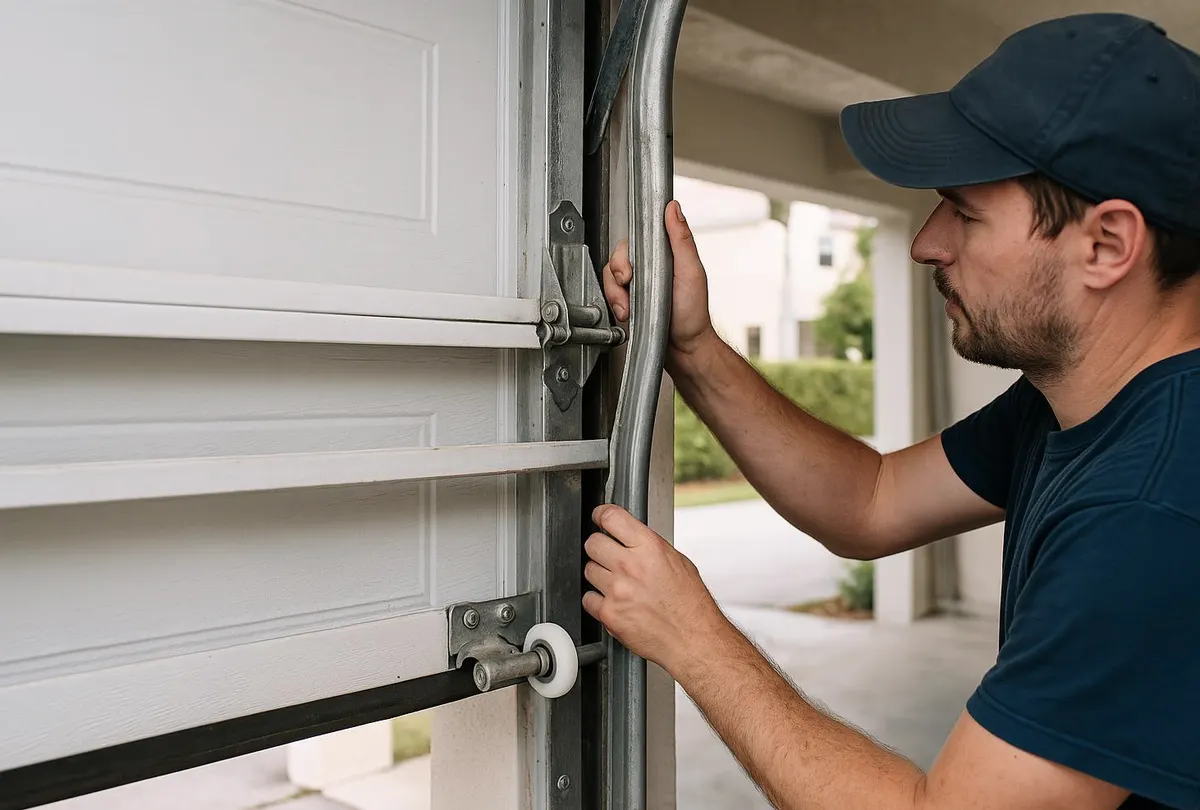
What a Technician Sees on This Kind of Call
A typical service call starts the same way: the homeowner says the door is "jumping" or "grinding" partway through its travel, or that one side drops before the other when it closes. Sometimes there's a visible gap of daylight at a bottom corner even though the door looks shut. On a walk-through, the tech usually finds a roller riding on the edge of the track instead of inside it, a track bracket that's wobbling when you shake it, or a section of track that's bowed outward just enough to catch the roller on every pass. In this part of New York, where winters bring repeated freeze-thaw cycles and a lot of the housing stock still has original garage doors and hardware from decades ago, worn fasteners and fatigued metal show up more often than in newer construction.
Symptoms Worth Paying Attention To
- The door jerks, hesitates, or grinds at the same spot every time it opens or closes
- A visible gap between the roller and the track, or a roller that's popped out entirely
- One side of the door reaches the floor before the other
- Light visible under or along the edge of a "closed" door
- The opener reverses mid-cycle as if it hit an obstruction, even though nothing is blocking it
- A scraping or metal-on-metal sound that wasn't there before
Any of these can look like an opener problem or a spring problem at first glance, which is why checking the tracks early in the diagnosis matters.
Causes, in the Order a Technician Checks Them
1. Loose or Shifted Mounting Brackets
This is the most common starting point, especially on older garages. The brackets holding the track to the frame can loosen over years of vibration, and in houses with original masonry or wood framing, freeze-thaw movement in the wall itself can nudge the anchors just enough to throw the track out of true. The fix is straightforward: re-securing or replacing the fasteners, shimming the bracket if the wall has shifted, and rechecking the track with a level before the call is closed out.
2. Physical Impact
Next, a tech looks for a visible bend or crease in the track itself — the kind of damage caused by a car bumper, a snowblower, a bike, or a ladder clipping the rail. A gentle curve can sometimes be worked back into shape with the right tools, but a sharp kink is different. Metal that's been creased has already fatigued at that point, and bending it back usually just means it fails again later, often at a worse angle. In those cases, replacing the damaged section of track is the more reliable fix, even though it costs more upfront.
3. Worn or Broken Rollers
Sometimes the track is fine and the real issue is the rollers. Steel rollers can crack in cold weather, and nylon rollers wear down and develop flat spots over time, which makes the door ride unevenly even in a perfectly straight track. Swapping worn rollers for new ones is a relatively quick fix and often resolves symptoms that looked, at first, like a serious track problem.
4. Damaged or Warped Door Panels
If a panel is dented, warped, or no longer sitting flush, it can pull the whole track assembly out of alignment every time the door travels — the panel is literally dragging the track with it. This is more common after storm debris strikes the door or after a minor collision. On a sectional door, replacing just the damaged panel is usually possible; on older, non-standard-sized doors common in this area's original housing stock, a matching panel may not be available, which sometimes makes full door replacement the more practical long-term option.
5. Structural Settling Around the Frame
Older homes shift over time, and seasonal freeze-thaw heaving under footings can gradually move a garage's jamb or header out of square. When that happens, the track can be perfectly straight and still be mounted to a frame that isn't. The fix here involves checking the door opening itself for square, adjusting the track mounting to compensate, and in some cases recommending a broader structural look if the movement is significant.
6. Winter Ice, Snow, and Salt Buildup
Finally, especially heading into a Rochester-area winter, a tech checks for ice refreezing at the point where the door meets the bottom track, and for salt spray corrosion pitting the track's surface after repeated plowing and de-icing. This doesn't bend the track, but it can jam a roller or create enough resistance that the opener forces the door against an obstruction, mimicking a true alignment problem. The fix is cleaning the track, applying a garage-door-rated lubricant (not household oil, which attracts grit), and confirming the opener's travel limits are set correctly.
When to Call Fairport Garage Door
If your door is grinding, dropping unevenly, or showing daylight at the edges, it's worth having it looked at before the first hard freeze locks in whatever's causing it. Our Garage Door Repair visits include a full track and roller inspection, and if the issue traces back to worn springs or hardware adding stress to the system, we can handle Spring Replacement in the same visit. Catching a bent track early usually means a smaller repair instead of a full track or panel replacement later.
If your garage door in Fairport, NY is sticking, jerking, or sitting unevenly, call Fairport Garage Door today and we'll get it running smoothly before winter sets in.